
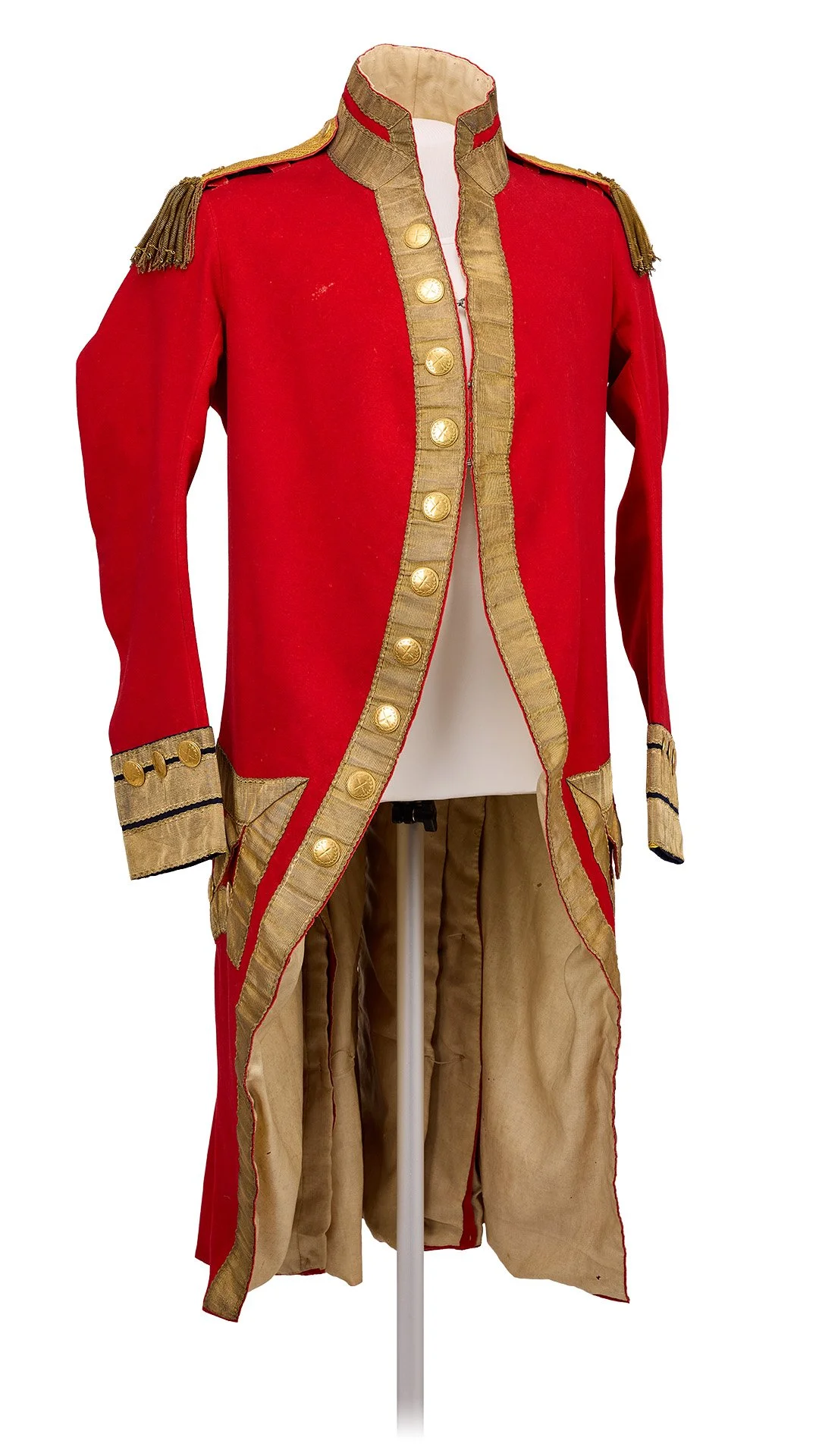
Nearly 250 years ago, British soldiers and their gear could be captured in war. In June 2026, an authentic British Red Coat from the American Revolution was captured again, this time photographically.
The Historical Association of Catawba County (HACC) and the History Museum of Catawba County in Newton, North Carolina, asked Kepchar, LLC to create a high-resolution 360° digital experience of the coat. It is one of a very small handful of original British Red Coats known to survive in the United States, and it is a remarkably rare piece of American Revolutionary history.
The finished project combines 36 high-resolution photographs into an interactive 360° view that lets visitors rotate the Red Coat, stop at any angle and examine its details up close.
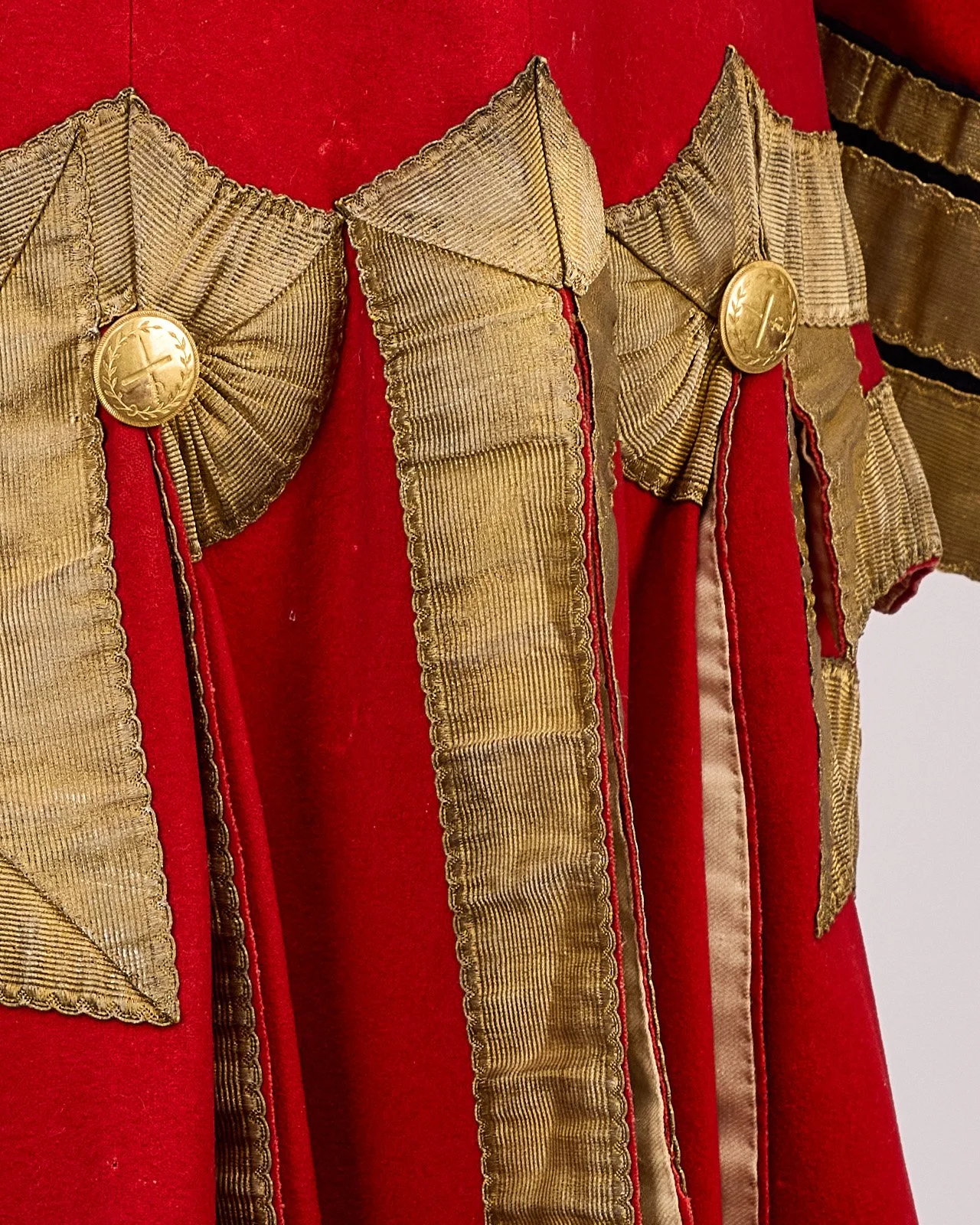
Drag to turn the coat. Zoom in on the lace, the buttons and the cuffs.
The question behind the project was bigger than "how do we photograph a coat?" It was this: how do you responsibly turn a rare, 250-year-old artifact into an interactive experience that anyone can explore from anywhere in the world?
Faithful, true-to-artifact digitization
This isn't a reproduction, a costume or an interpretive piece. Someone wore this coat. It was made from real materials by real hands, and it has survived long enough to reach us.
That changes how you approach the work. The job of digitization is to produce accurate, true-to-artifact imagery that can serve as a reliable historical record for historians, students and the public. That means showing the coat exactly as it exists today, including its form, materials, color, texture, construction, wear and character. It is not about making the coat look better than it is.
Artifact care comes first
For a museum object, care comes before photography. HACC's collections care experts directed all handling, movement, positioning and support of the coat. From the photographer's side, the rule was simple: look, but don't touch.
Our workflow was built to keep handling and physical stress to a minimum. Instead of repositioning the coat for each view, we designed the imaging setup so the artifact stayed carefully positioned while the rotational sequence was captured around it. That's one of the real advantages of controlled 360° digitization for collections work: you can capture a great deal of visual information without constantly moving the object.
Planning before the coat arrived
The capture was only one part of the project. Before the coat ever reached the studio, the museum team visited our production studio at the Manufacturing Solutions Center (MSC) in Conover, North Carolina. Together we walked through the setup, talked through transportation and handling, checked the mannequin's height and position, and made sure the plan felt safe and straightforward.
The coat was dressed on a mannequin chosen to give the garment its natural human form while visually receding, so the Red Coat itself stays the focus.
(Our internal sign-off while coordinating the shoot: "The British are coming!")
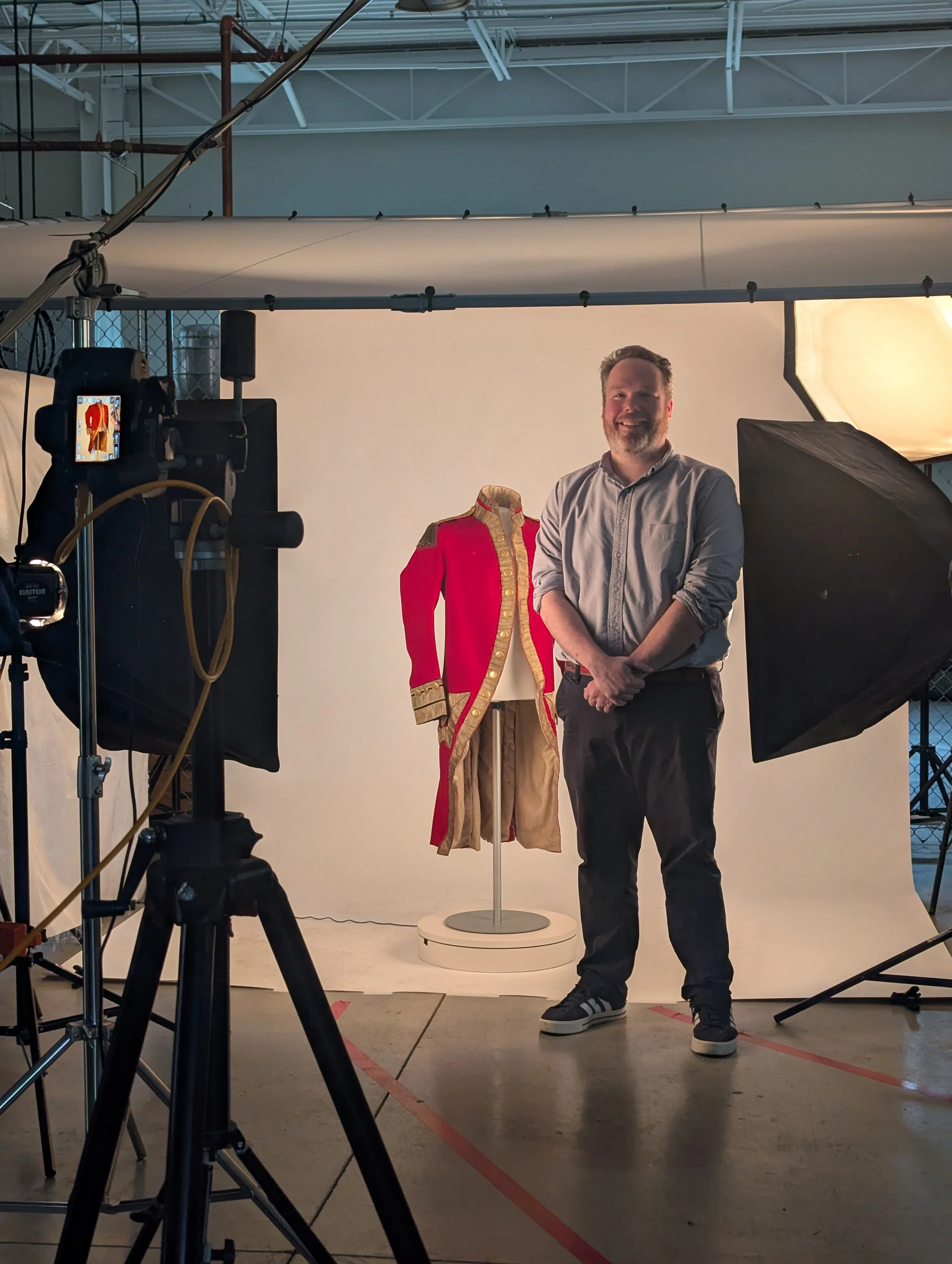
36 frames, one controlled sequence
The coat was captured as a complete high-resolution sequence of 36 images that together make a smooth 360° rotation. Each frame had to work on its own and as part of the sequence.
That makes consistency critical. Camera position, lighting, exposure, color, perspective, mannequin position, and the relationship between the coat and the background all had to stay locked throughout. A small change you'd never notice in a single still becomes distracting once the frames are animated side by side. We photographed a color target to establish consistent, accurate color reproduction across the sequence, and we used tethered capture so we could check every frame on a calibrated monitor as we went.
The lighting had to reveal the coat's true shape, color and fabric texture accurately, without dramatizing it. Every image is a real photograph of the real object, not a computer-generated version of it.
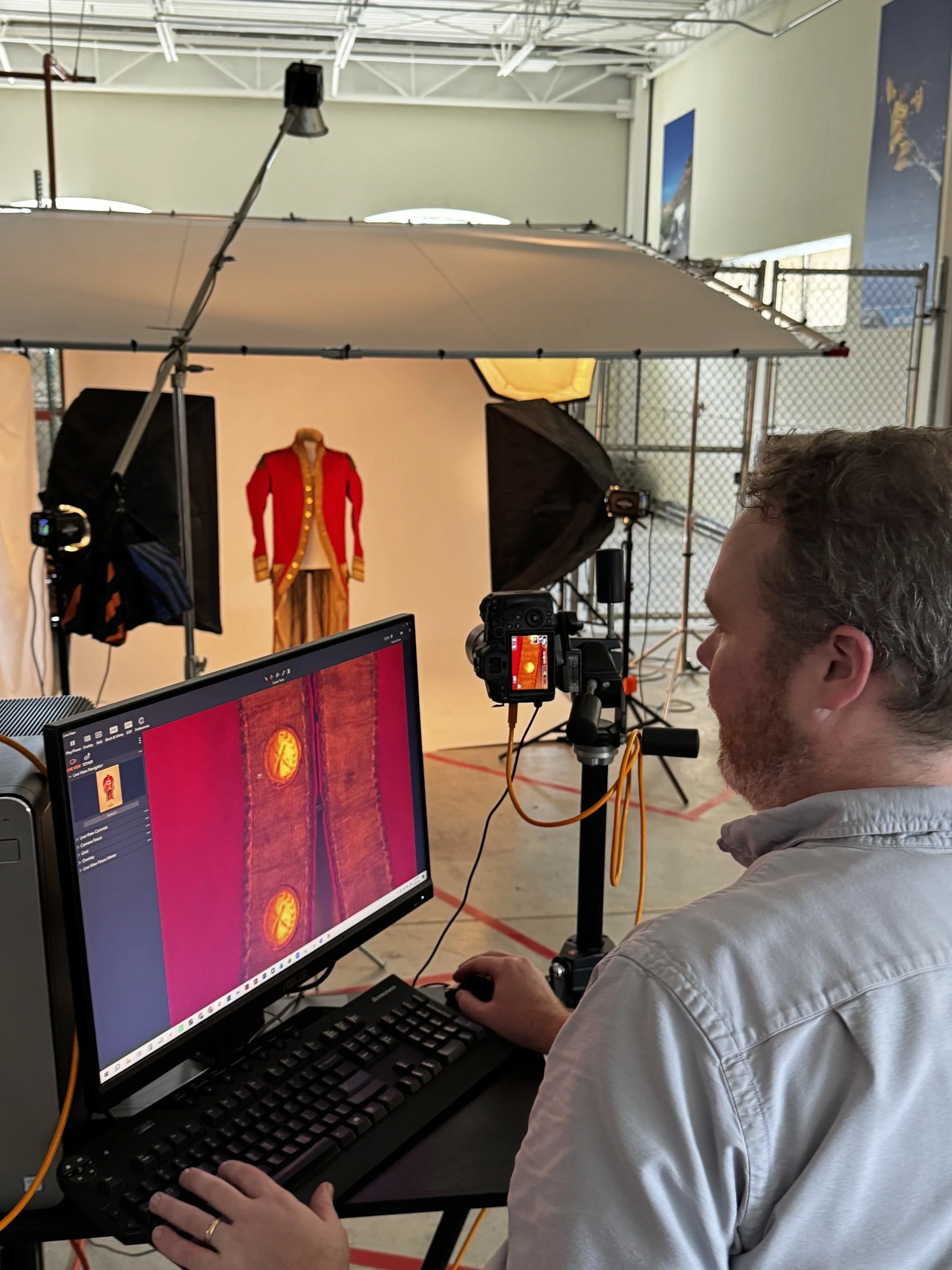
Post-production with a high bar
A historic garment has one of the most complicated silhouettes you can photograph. Fabric edges, folds, cuffs, tails, seams, openings and small irregularities all had to stay believable from frame to frame. As John put it to the museum at the time: "It's a complex edge, and I want to make sure I do him all the justice he deserves. High bar."
This wasn't about digitally rebuilding or beautifying the artifact. It was about removing distractions left by the photographic process while keeping the coat's real character, consistently across all 36 frames.
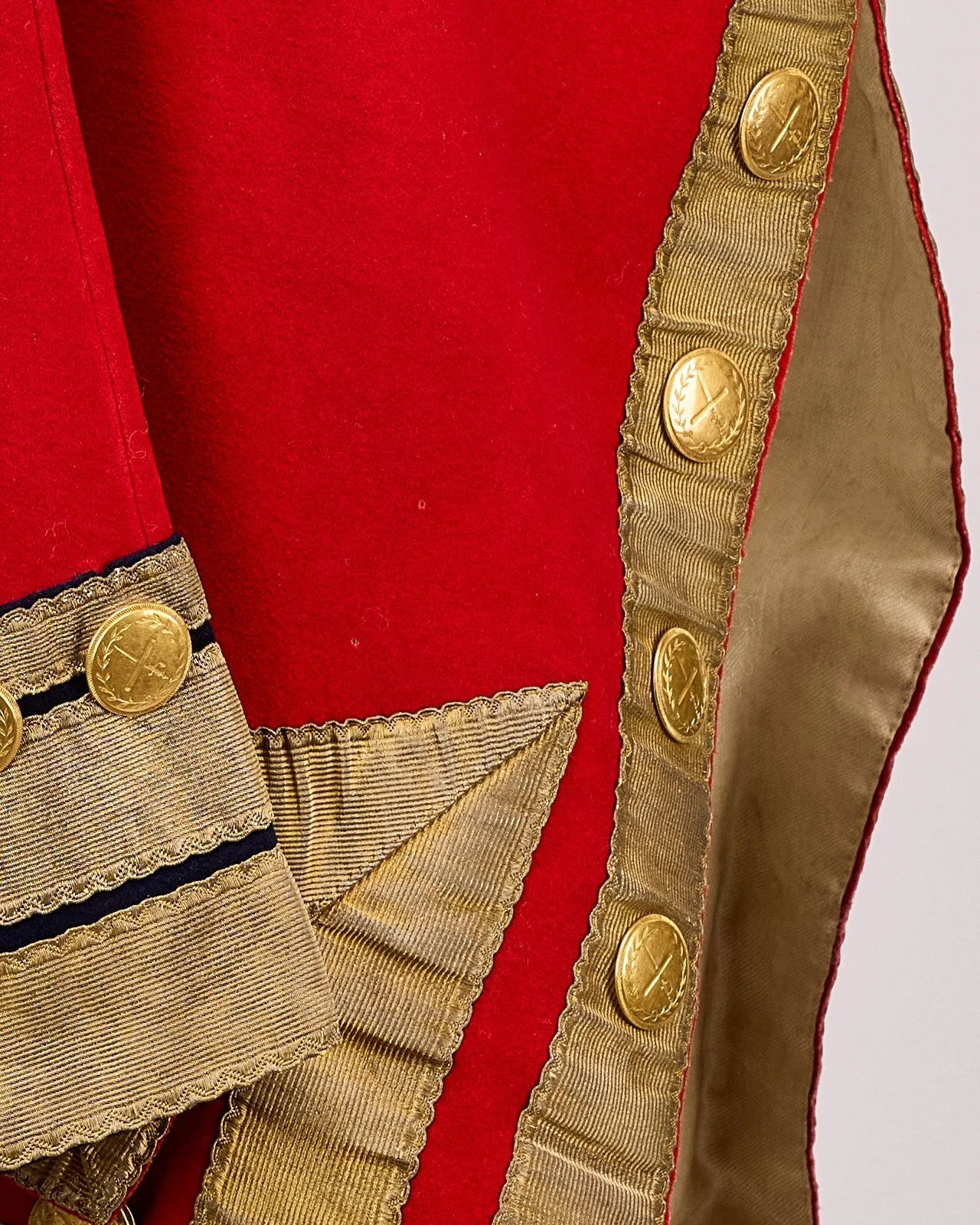
Handing control to the viewer
The result isn't a folder of photographs. It's an interactive experience: a visitor can turn the coat, stop at any angle and take their time with the details. A traditional photograph tells you where to look. An interactive object gives some of that control back to you.
For museums, that opens up education, research, accessibility, outreach and storytelling. Nobody has to travel to Newton to discover that this artifact exists. The digital version doesn't replace seeing the real coat. It creates another doorway into it, and ideally it sends more people to see it in person.
See the finished experience on HACC's Red Coat page.
What we delivered
High-resolution photographic capture
A 36-image rotational sequence
An interactive hosted 360° experience
Email and web GIFs
Three social media videos
Digital assets supporting the museum's public launch and promotion
Why it matters for America's 250th
As museums and communities prepare for America's 250th anniversary, objects like this make history tangible. It's easy for the Revolution to shrink into dates, names and textbook paragraphs. A real garment brings the period much closer. Digitization gives museums another way to connect their collections with audiences during America 250 and well beyond it.
From one artifact to an entire collection
The Red Coat is one example of how Kepchar, LLC helps museums, historic sites, archives and collections give important physical objects a useful digital life. That includes high-resolution photography, 360° imaging, technical digitization, interactive presentation, video and animation, all done with a conservation-minded workflow and museum-directed handling. Every artifact is a new problem to solve, so we build the process around the object. We work in our studio at the Manufacturing Solutions Center in Conover, NC, or on site at your institution.
FAQ
What is 360° artifact photography? It's a sequence of real photographs taken around an object, combined into an interactive view that people can turn and zoom. Nothing is modeled or computer generated.
How many images does a 360° view take? The Red Coat used 36 frames for a smooth full rotation. Larger or more complex objects may need more.
Is 360° imaging safe for fragile artifacts? It can be, with the right planning. For the Red Coat, museum staff directed all handling and positioning, and the setup kept the coat in place while the sequence was captured, which keeps handling and stress to a minimum.
Do you photograph on site or in a studio? Both. We have a production studio at the Manufacturing Solutions Center in Conover, NC, and we also work on site at museums and collections.
What do museums receive? For this project: high-resolution captures, the 36-image sequence, a hosted interactive 360° experience, GIFs, social videos, and launch and promotion assets.
By John Kepchar, Kepchar, LLC.